
A fun find!
Ya just never know what you’re gonna find, do ya now? A recent visit to a new antique store turned up a fun find! Fest your eyes on the Party Patty Pac Shell & Waffle Molds! Just dip and deep fry! Serve as main dishes or desserts- Stays fresh for days.
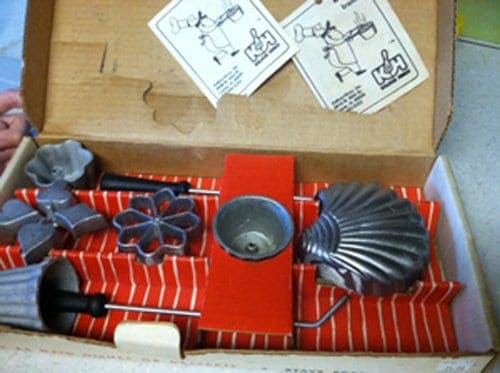
Party pac rosette molds
Now I couldn’t find a date on the box or materials and some quick internet searching didn’t get me far at all. So really, I am not sure how old these are but they are classic in my eyes. The insert suggests that these work great as a main dish serving as well as dessert. Fill shells with creamed meat or creamed fish! I can only imagine that a jello salad on the side would complete your meal. Now me, I’m partial to the dessert rosette. And I like them with plenty of sugar sprinkled on. Mmmm….so good. A little grease is always good for the system!?
Here’s the recipe from the insert:
1 cup flour
1/2 cup evaporated milk
1/2 cup water*
1 teas. sugar
1/2 teas. salt
1 egg, unbeaten
Mix milk, water, sugar, salt and egg together. Stir slowly into flour, then beat until smooth with rotary beater at medium speed. Makes about 36 shells. Cooking oil must be 365 degrees throughout cooking, if temp. drops you’ll have soggy,greasy cookies. *1/2 cup beer can be substituted in place of water for beer recipe.
Here’s the adjusted recipe (owner’s handwritten notes on the side- love those!):
1/2 c flour
1/2 c cornstarch
1 c evaporated milk
1 Tbsp sugar
1/4 teas salt
2 eggs
1/2 teas vanilla
Eating with the Ancestors
Submitted by Marcy-Jean Mattson
June 28, 2012
I recently visited some very old relatives. Although they have been dead for many years, we communed for over an hour making a recipe of lefse, the traditional Norwegian potato flat bread. Although lefse was traditionally a daily bread, our family now sees it only at the Thanksgiving table.
I still remember being in Grandma’s basement kitchen- standing next to the old gas stove while Grandma Julia taught my younger cousin Jill and me to bake the sheets of lefse. Julia rolled the dough paper-thin, then transferred the round to the griddle on a long, thin wooden stick using a practiced hand motion that rolled the sheet across the grill. Jill and I watched big bubbles develop as the round started to cook. When the first side was browned, we would slide the wooden stick under the dough and flip it- imitating Grandma’s hand movements. I remember the silky feel of the dough as I moved it on the grill and the smell of cooked flour.
Jill and I spent lots of time “helping” Grandma. I always figured we were pulled in to work because she wanted help and didn’t understand the rules about child labor. It wasn’t until years later that I realized that cooking with two little girls was not the most efficient use of her time and very out of character for the impatient Julia. I remember the conversations as she told us about learning to make lefse from Jenny, her Mom, who had emigrated from Norway as a child. Grandma, in her way, was trying to pass the tradition to us.
My Dad, brother and I tried making lefse after Grandma died and the results were utter failures. The dough was too sticky and would not roll properly – the dough absorbed too much flour. We hadn’t a clue how the dough should feel. The resulting rounds were as crisp as potato chips, not soft and pliant like Grandma’s. Grandma Julia, like the women before her, didn’t measure ingredients – she added flour to the mashed potatoes until the dough “felt” right. My cousin and I helped Grandma cook the lefse, but only Grandma knew the secret mixing the dough.
Several years ago, I heard a food scientist on National Public Radio explain that the starch in potatoes is best worked very cold. I made mashed potatoes that night and secretly made lefse the next night. It worked! The dough was light and pliable and rolled beautifully. I asked Dad if Grandma used cold potatoes and he said she had – he had known the secret all along, but hadn’t realized it. Best of all, when Dad tasted a sample, he pronounced it almost as good as Julia’s. The ultimate compliment.
Traditions are the glue that keep families together- and most of them involve food! Garrison Keillor says you cook with the ancestors and eat for the ancestors. We eat the peasant food, the food of survival that brought us this far. Do you have memories of a food that your Grandma or Auntie made, but don’t have a recipe? It is worth the time and effort to try and recreate the taste the tradition to pass on to your family.
Yeah June!
Ahhh June! I didn’t know if it was ever going to get here and then it got here too fast! I’m excited though! June kicks of summer and means warm weather, weddings, reunions, VACATIONS, and campfires. Now that’s good times! And it means we’ll be hustling and bustling in the gift shop getting to know all of our new visitors. Introducing some guests to lefse for the first time. I love the apprehension and then the “mmmm, that’s really good” after they try a sample of our homemade lefse. Brings a smile to my face every time. So if you’re traveling up or down the Great River Road Scenic Byway (voted the #1 Prettiest Drive in the US), swing on in, say hi, try a sample and enjoy your summer FUN!
Lefse Time’s Lefse Recipe
Ingredients
- 4 cups riced potatoes
- 1/4 cup butter
- 1/2 cup heavy whipping cream
- 2 tsp sugar
- 1 tsp salt
- 1 1/2 cups flour
Find a lefse grill or lefse making equipment to make your own lefse!
Click here to view detailed instructions for making this lefse recipe.
For even more lefse recipes, visit our customer submitted recipes. Have a favorite recipe of your own you want to share on Lefse Time? Submit it here!